










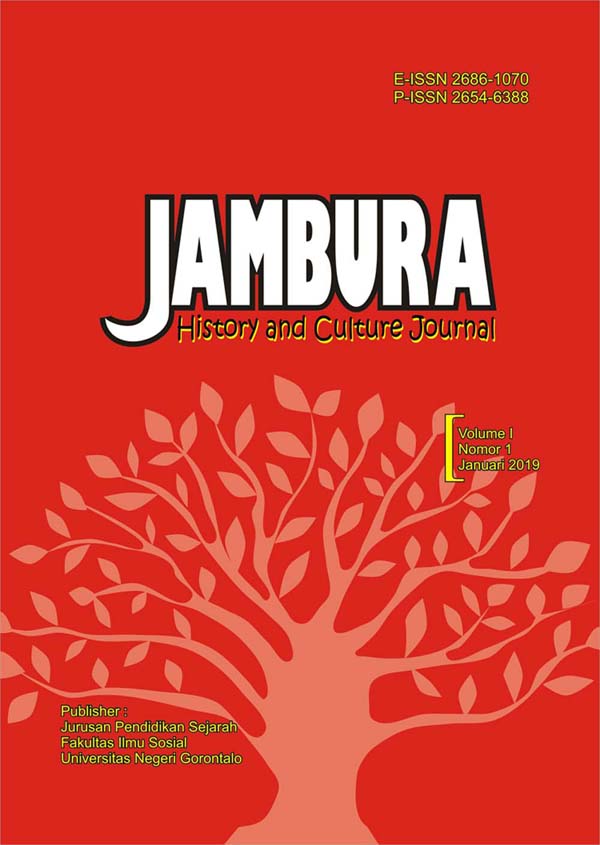
Jambura History and Culture Journal is an open access and peer-reviewed journal dedicated to providing an international academic platform for research in historical studies, historical education, and cultural analysis. The journal focuses on a broad range of topics related to history and culture, including but not limited to areas such as global and regional history, cultural heritage, historical education, cultural practices, and interdisciplinary approaches to understanding the past and its impact on present-day society. Authors are encouraged to submit manuscripts that fall within the scope of Jambura, History and Culture Journal. All submissions undergo a rigorous double-blind peer-review process, ensuring that both the authors' and reviewers' identities remain anonymous to guarantee an unbiased evaluation. The final decision on whether an article is accepted for publication lies with the Editorial Board, based on recommendations from peer reviewers. Before submitting a manuscript, authors should carefully review and adhere to the authors' guidelines provided by the journal. It is essential that manuscripts conform to the specified guidelines and formatting requirements. Submissions that do not meet these standards will be rejected by the editorial team before the review process begins. Only manuscripts that comply with the formatting and submission guidelines will be considered for review and possible publication.
Announcements
Call For Papper: Volume 8, No 2 July 2026 |
|
| We are pleased to announce that Jambura, History and Culture Journal, which has been accredited SINTA 5, is now accepting article submissions for our upcoming issue, Volume 8 No. 2, scheduled for publication in July 2026. We welcome original research articles, review papers, and case studies aligning with our focus on historical studies, education, and cultural analysis. | |
| Posted: 2026-02-24 | |
| More Announcements... |
Vol 8, No 1 (2026): Januari
Table of Contents
Articles
|
Alfian Alfian,
Universitas Syiah Kuala,
Indonesia
Muhammad Haikal, Universitas Syiah Kuala, Indonesia Muhammad Al-Farisy, Universitas Syiah Kuala, Indonesia |
1-16
|
 DOI :
DOI :  Abstract views : 158 times
|
Fitra Widya Wati,
Universitas Negeri Makassar,
Indonesia
|
17-35
|
|
Inas Amatullah El Wachidah,
Balakala Bhumi Apsara,
Indonesia
Salma Fitri Kusumastuti, Balakala Bhumi Apsara, Indonesia |
36-62
|
|
Aditya Revianur,
Universitas Gadjah Mada,
Indonesia
|
63-90
|
|
Fuji Astuti,
Universitas Samudra,
Indonesia
Ardian Fahri, Universitas Samudera, Indonesia Mayang Indah, Universitas Samudera, Indonesia |
91-110
|
|
Kesya Payungallo,
Universitas Negeri Makassar,
Indonesia
Muh Said, Universitas Negeri Makassar, Indonesia Shasliani Shasliani, Universitas Negeri Makassar, Indonesia |
111-129
|
|
Kautsar Niara,
Universitas Syiah Kuala,
Indonesia
Muhammad Andika Nugraha, Universitas Syiah Kuala, Indonesia Ema Agustina, Universitas Lampung, Indonesia |
130-148
|
|
Dimas Aldi Pangestu,
Universitas Pendidikan Indonesia,
Indonesia
Naufal Raffi Arrazaq, Universitas Negeri Gorontalo, Indonesia |
149-172
|

Jambura History and Culture Journal (ISSN Online: 2686-1070 | ISSN Print: 2654-6388) is licensed under a Creative Commons Attribution 4.0 International License.