


 Email this article







Fractional-Order COVID-19 Model in Indonesia with Comorbidity and Immunization: PID Control, Ulam-Hyers Stability, and Biosecurity Implications
Abstract
Keywords
Full Text:
PDFReferences
Worldometers“Indonesia COVID - Coronavirus Statistics," https://www.worldometers.info/coronavirus/, 2021, Accessed on 15 April 2021.
WHO, “Pertimbangan-pertimbangan untuk karantina individu dalam konteks penanggulangan penyakit coronavirus (COVID-19)," 2020.
M. Coccia, “Improving preparedness for next pandemics: Max level of COVID-19 vaccinations without social impositions to design effective health policy and avoid flawed democracies," Environmental research, vol. 13, p. 113566, 2022. DOI:10.1016/j.envres.2022.113566
M. A. Rois, Fatmawati, and C. Alfiniyah, “Two isolation treatments on the COVID-19 model and optimal control with public education," Jambura Journal of Biomathematics (JJBM), vol. 4, no. 1, pp. 88–94, 2023. DOI:10.34312/jjbm.v4i1.19963
M. A. Rois et al., “Modeling and optimal control of COVID-19 with comorbidity and three-dose vaccination in Indonesia," Journal of Biosafety and Biosecurity, vol. 6, no. 3, pp. 181–195, 2024. DOI:10.1016/j.jobb.2024.06.004
M. Caputo and M. Fabrizio, “A new definition of fractional derivative without singular kernel," Progress in Fractional Differentiation & Applications, vol. 1, no. 2, pp. 73–85, 2015.
J. Losada and J. J. Nieto, “Properties of a new fractional derivative without singular kernel,". Progr. Fract. Differ. Appl., vol. 1, no. 2, pp. 87–92, 2015.
A. Atangana and B. S. T. Alkahtani, “Analysis of the Keller Segel model with a fractional derivative without singular kernel," Entropy, vol. 17, no. 6, pp. 4439–4453, 2015. DOI:10.3390/e17064439
M. Farman et al., “A control of glucose level in insulin therapies for the development of artificial pancreas by Atangana Baleanu derivative,". Alexandria Engineering Journal, vol. 59, no. 4, pp. 2639–2648, 2020. DOI:10.1016/j.aej.2020.04.027
M. Toufik and A. Atangana, “New numerical approximation of fractional derivative with non-local and non-singular kernel: application to chaotic models," The european physical journal plus, vol. 132, pp. 1–16, 2017. DOI:10.1140/epjp/i2017-11717-0
M. A. Khan et al., “The dynamics of COVID-19 with quarantined and isolation," Advances in Difference Equations, vol. 2020, no. 1, p. 425, 2020. DOI:10.1186/s13662-020-02882-9
E. M. Abd-Elaziz, M. Marin, and M. I. Othman, “On the effect of Thomson and initial stress in a thermo-porous elastic solid under GN electromagnetic theory," Symmetry, vol. 11, no. 3, p. 413, 2019. DOI:10.3390/sym11030413
S. Jamil et al., “Stability and complex dynamical analysis of COVID-19 epidemic model with non-singular kernel of Mittag-Leffler law," Journal of Applied Mathematics and Computing, vol. 70, pp. 3441–3476, 2024. DOI:10.1007/s12190-024-02105-4
M. Farman et al., “Numerical study and dynamics analysis of diabetes mellitus with co-infection of COVID-19 virus by using fractal fractional operator," Scientific Reports, vol. 14, no. 1, p. 16489, 2024. DOI:10.1038/s41598-024-60168-6
P. A. Naik et al., “Analysis and modeling with fractal-fractional operator for an epidemic model with reference to COVID-19 modeling," Partial Differential Equations in Applied Mathematics, vol. 10, p. 100663, 2024. DOI:10.1016/j.padiff.2024.100663
K. S. Nisar et al., “A review of fractional order epidemic models for life sciences problems: Past, present and future," Alexandria Engineering Journal, vol. 95, pp. 283–305, 2024. DOI:10.1016/j.aej.2024.03.059
M. Farman and C. Alfiniyah, “A constant proportional caputo operator for modeling childhood disease epidemics," Decision Analytics Journal, vol. 10, p. 100393, 2024. DOI:10.1016/j.dajour.2023.100393
A. Atangana, “Fractal-fractional differentiation and integration: connecting fractal calculus and fractional calculus to predict complex system," Chaos, solitons & fractals, vol. 102, pp. 396–406, 2017. DOI:10.1016/j.chaos.2017.04.027
A. Atangana and D. Baleanu, “New fractional derivatives with nonlocal and non-singular kernel: Theory and application to heat transfer model," Thermal Science, vol. 20, no. 2, pp. 763–769, 2016. DOI:10.2298/TSCI160111018A
L. C. D. Barros et al., “The memory effect on fractional calculus: an application in the spread of COVID-19," Comp. Appl. Math., vol. 40, no. 3, p. 72, 2021. DOI:10.1007/s40314-021-01456-z
R. Zarin and U. W. Humphries, “Modeling the dynamics of COVID-19 Epidemic with a reaction-diffusion framework: a case study from Thailand,"a˘Eur. Phys. J. Plus,a˘vol. 139, p. 1076, 2024. DOI:10.1140/epjp/s13360-024-05870-0
W. Wu et al.,a˘“The effect of time delay on the dynamics of a fractional-order epidemic model,"a˘Adv Cont Discr Mod, vol. 9, pp. 1–33, 2025. DOI:10.1186/s13662-025-03868-1
J. Ssebuliba et al.), “Mathematical modelling of COVID-19 transmission dynamics in a partially comorbid community," Partial Differential Equations in Applied Mathematics, vol. 5, p. 100212, 2022. DOI:10.1016/j.padiff.2021.100212
V. Ambalarajan et al., “Multi-strain COVID-19 dynamics with vaccination strategies: Mathematical modeling and case study," Alexandria Engineering Journal, vol. 119, pp. 665-684, 2025. DOI:10.1016/j.aej.2025.01.105.
DOI: https://doi.org/10.37905/jjbm.v6i4.34027
Copyright (c) 2025 Muhammad Farman, Cicik Alfiniyah, Fatmawati, Muhammad Abdurrahman Rois, Khadija Jamil

This work is licensed under a Creative Commons Attribution-NonCommercial 4.0 International License.
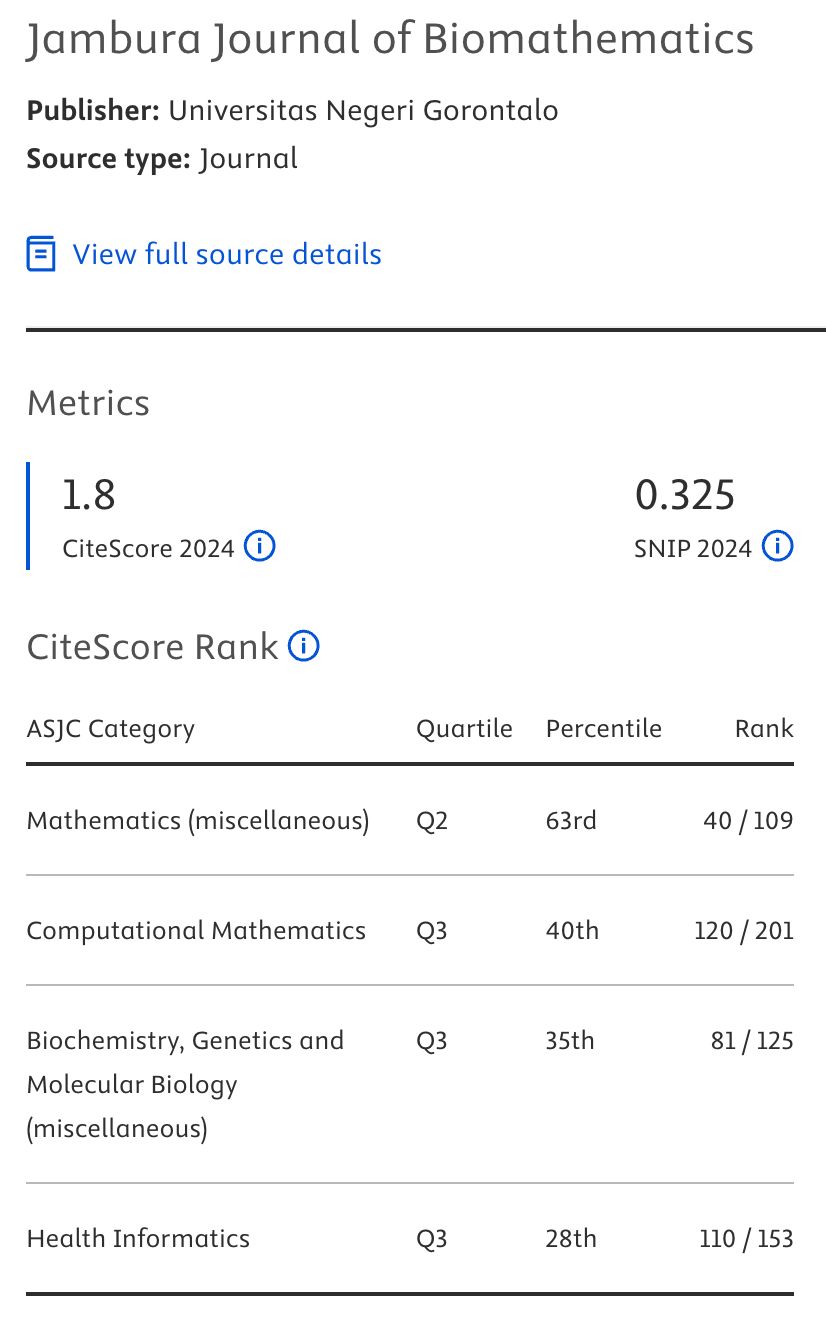
Jambura Journal of Biomathematics (JJBM) has been indexed by:








EDITORIAL OFFICE OF JAMBURA JOURNAL OF BIOMATHEMATICS |
 | Department of Mathematics, Faculty of Mathematics and Natural Science, Universitas Negeri Gorontalo Jl. Prof. Dr. Ing. B. J. Habibie, Moutong, Tilongkabila, Kabupaten Bone Bolango 96554, Gorontalo, Indonesia |
 | Email: [email protected] |
 | Jambura Journal of Biomathematics (JJBM) by Department of Mathematics Universitas Negeri Gorontalo is licensed under a Creative Commons Attribution-NonCommercial 4.0 International License. Powered by Public Knowledge Project OJS. |