


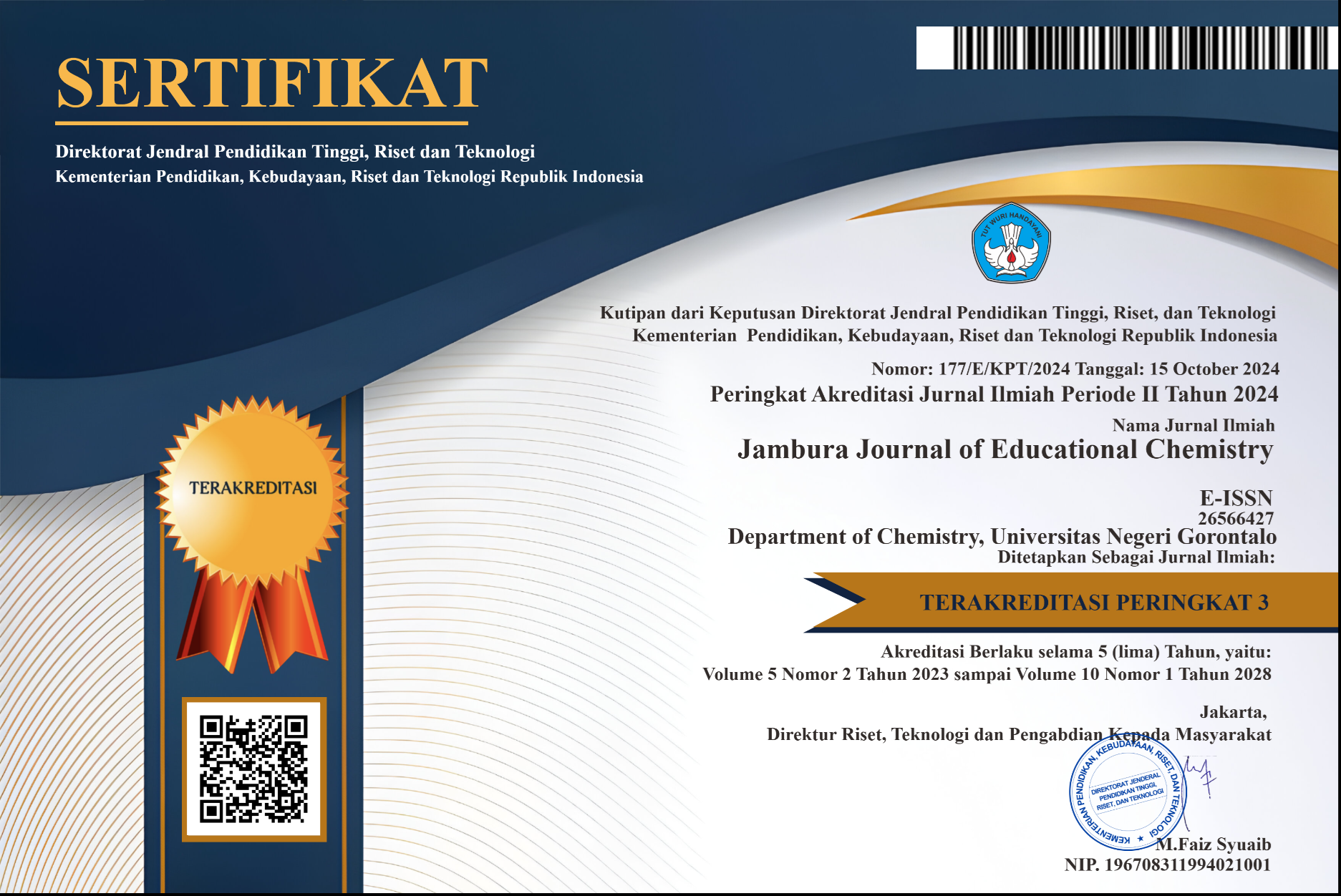








Effectiveness of the Conceptual Understanding Procedures (CUPS) Learning Model on Students' Higher-Order Thinking Skills in Basic Chemical Law Material
Abstract
Keywords
Full Text:
PDFReferences
Abosalem, Y. (2015). Assessment techniques and students‟ higher-order thinking skills. ICSIT 2018 - 9th International Conference on Society and InformationTechnologies, Proceedings,4(1),61–66. https://doi.org/10.11648/j.ijsedu.20160401.11
Agung, GH, & Ardiansyah, AS (2023). Study of the Cups Learning Model Assisted by e-LKPD on Mathematical Problem Solving Ability. Proceedings of the National Mathematics Seminar, 6, 360–366.
Ali, F. S. (2019). Implementation of HOTS in the 2013 Curriculum. Inventa, 3(1), 1–17.
Anwar, D. N., Yusuf, Y., & Jaenudin, A. (2023). The implementation of the Conceptual Understanding Procedures (CUPs) learning model to improve mathematical communication skills. Pendidikan Matematika Sebelas April, 1(2), 11–22.
Ardianti, N. (2020). The effect of the cooperative learning model type Conceptual Understanding Procedures (CUPs) on the learning outcomes of seventh-grade students. Inspiramatika, 5(1), 34–42.
Agustina, P. (2023). The effect of the Conceptual Understanding Procedures (CUPs) learning model on the mathematical conceptual understanding of fourth-grade students at SDN 4 Natar, South Lampung (Doctoral dissertation, UIN Raden Intan Lampung).
Fitriani, N., Gunawan, & Sutrio. (2017). Creative thinking in physics through the Conceptual Understanding Procedures (CUPs) learning model assisted by student worksheets (LKPD).
Jufri, A. P., Asri, W. K., Mannahali, M., & Vidya, A. (2023). Strategi pembelajaran: Menggali potensi belajar melalui model, pendekatan, dan metode yang efektif. Ananta Vidya.
Prayitno, A., & Nofiana, M. (2021). Development of a High Order Thinking Skills Evaluation Instrument for Animal Tissue Material Using a Two-Tier Multiple Choice Question Format. Bioed: Journal of Biology Education, 8(1), 1. https://doi.org/10.25157/jpb.v8i1.5959
Pancawani, A.-, Sodiq, A., & Negara, HS (2023). The Conceptual Understanding Procedures (CUPs) Learning Model for Fourth Grade Elementary School Students' Understanding of Mathematical Concepts. Terampil: Journal of Elementary Education and Learning, 10(2), 246. https://doi.org/10.24042/terampil.v10i2.19249
Putri, D. A. (2019). The effect of the Conceptual Understanding Procedures (CUPs) learning model assisted by didactic design modules on improving the mathematical conceptual understanding ability of eighth-grade students at SMP Negeri 7 Kotabumi.
Pratiwi, Soedjoko, & Mulyono. (2014). The effectiveness of the Conceptual Understanding Procedures learning model in improving students’ abilities in the aspect of mathematical connections. Kreano: Jurnal Matematika Kreatif-Inovatif, 5(1), 41–47.
Nurfaqihah, RR, Fatimah, AT, & Effendi, A. (2023). Conceptual Understanding Procedures (CUPs) Learning Model to Improve Students' Mathematical Concept Understanding Ability Reviewed from Mathematical Disposition. J-KIP (Journal of Teacher Training and Education), 4(2), 476. https://doi.org/10.25157/j-kip.v4i2.9016
Nugroho, I., Wilujeng, I., & Pujaningsih, P. (2024). How Elementary Science Teachers’ Understand Perform Science Process Skills and HOTS (Vol. 1, Issue Bishss 2023). Atlantis Press SARL. https://doi.org/10.2991/978-2- 38476-273-6_20
Sururuddin, M. (2015). The development of the Conceptual Understanding Procedures (CUPs) learning model in science subjects at the elementary school level. Jurnal EducatiO, 10(1), 118–130. https://e-journal.hamzanwadi.ac.id/index.php/edc/article/view/93/72
Saregar, A., Latifah, S., & Sari, M. (2016). The Effectiveness of the CUPs Learning Model: Impact on the Higher-Order Thinking Skills of Students at Madrasah Aliyah Mathla"ul Anwar Gisting Lampung. Al-Biruni Scientific Journal of Physics Education, 5(2), 233–244. https://doi.org/10.24042/jpifalbiruni.v5i2.123
Wahab, G., & Rosnawati. (2021). Theories of learning and instruction. In Paper Knowledge. Toward a Media History of Documents (Vol. 3, Issue April).
Wildana, IW (2017). HOTS question preparation module.
Yee Mei Heong, Widad Binti Othman, Jailani Bin Md Yunos, Tee Tze Kiong, Razali Bin Hassan, & Mimi Mohaffyza Binti Mohamad. (2011). The Level of Marzano Higher Order Thinking Skillsamong Technical Education Students. International Journal of Social Science and Humanity, 1(2).
Yulianti, E., Sulistri, E., & Rosdianto, H. (2020). The Effect of the Conceptual Understanding Procedures Learning Model on Students' Critical Thinking Skills on Vibrations and Waves. Journal of Physics Education, 8(1), 9–17.
DOI: https://doi.org/10.37905/jjec.v7i2.33884
Refbacks
- There are currently no refbacks.
Editorial Office

|
Department of Chemistry, Universitas Negeri Gorontalo |

|
E-mail: [email protected] |

|
Jambura Journal of Educational Chemistry (p-ISSN: 2655-7606 | e-ISSN: 2656-6427) by Department of Chemistry Universitas Negeri Gorontalo. This work is licensed under a Creative Commons Attribution 4.0 International License. Powered by Public Knowledge Project OJS |